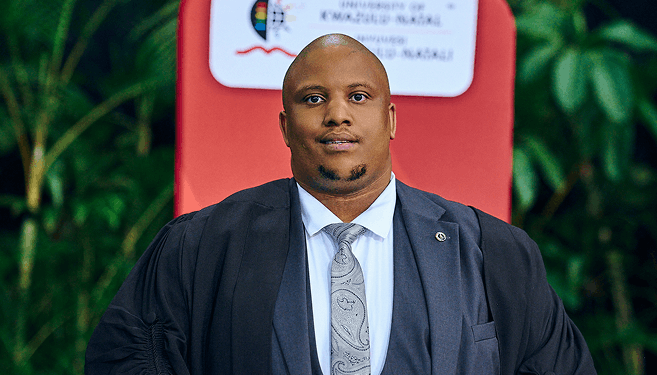
Research by a University of KwaZulu-Natal (UKZN) graduate focused on preventing the deterioration of electricity transformers which are essential components of South Africa’s power grid.
The research secured Mr Mhlengi Msomi a Master of Science in Chemistry from UKZN for his study titled: ‘Physicochemical Evaluation of Synthetic and Insulating Oils in Liquid-Filled Transformers with Chemical and Possible Green Novel Passivation of Copper Windings’.
Msomi, supervised by Dr Ajay Bissessur, Professor Thishana Singh and Dr Hogantharanni Govender, said: “I developed a strong interest in this topic during my Honours year and felt that there was still a great deal to explore. Knowing that my research could contribute to solving a real-world problem, the decision to continue my studies at UKZN was an easy one.”
Msomi’s interest in the research was driven by a desire to combine sustainable chemistry with solutions to South Africa’s energy challenges.
“Growing up and studying in South Africa, I witnessed the impact power interruptions have on communities, businesses and economic development. I wanted to contribute to research that could improve the reliability of our electricity infrastructure,” he said.
Msomi explained that copper wiring inside a transformer is wrapped in paper insulation and immersed in insulating oil. Over time, chemical reactions can occur inside the transformer, causing copper sulfide deposits to form on the paper insulation. These deposits reduce the insulating properties of the paper and can eventually lead to transformer failure, resulting in power outages and costly repairs.
He investigated ways to prevent this deterioration by testing protective chemical coatings, known as passivators, that form a barrier on the copper surface and reduce corrosion. He compared benzotriazole, a commonly used synthetic chemical, with caffeine as a potential environmentally friendly alternative. He also compared traditional mineral oils with more sustainable plant-based insulating oils.
“The results showed that plant-based oils slowed the ageing process more effectively than conventional mineral oils,” he said. “Although caffeine showed potential as a greener alternative, it was not as effective as benzotriazole in preventing copper sulfide formation.”
He was also interested in green chemistry and the possibility of investigating whether a naturally occurring compound such as caffeine could replace a conventional industrial chemical. Another motivation was the limited research conducted on transformer degradation under South African operating conditions. “I wanted to contribute locally relevant research that could have a direct impact on industry,” he said.
Msomi believes the practical application of his findings could be significant. “The work can provide information to help power utilities to make better decisions about transformer maintenance, improve the reliability of the electrical grid and reduce infrastructure costs,” he said. “It can help utilities such as Eskom develop more effective maintenance strategies that strengthen South Africa’s energy security.”
Msomi’s MSc journey was complicated by significant personal challenges. During his studies, he lost his mother under tragic circumstances. Her passing changed his life and meant that he had to take on additional family responsibilities, and he switched from full-time to part-time study so that he could support and care for his siblings while working as a laboratory technician in UKZN’s Geology discipline.
“Balancing family responsibilities, employment, and postgraduate research was incredibly challenging, but it also taught me resilience, discipline, and perseverance,” he said.
He thanked his family, supervisors, colleagues and staff in the Chemistry and Geological Sciences departments for their support, guidance and encouragement.
“Completing an MSc is never an individual achievement. It is the result of support, sacrifice, and perseverance,” he said.
In his spare time, Msomi enjoys being with family and friends, learning new things and keeping abreast of developments in science and technology.
Reflecting on his journey, he said: “Life does not always unfold according to plan. There were moments when continuing seemed impossible, but I learned that progress is not always measured by speed. Sometimes, simply refusing to give up is the greatest achievement.
“Challenges may change the path, but they do not have to change the destination,” he added.
Words: Sally Frost
Photograph: Sethu Dlamini