Research published in the Current Biology journal and co-authored by the University of KwaZulu-Natal’s (UKZN) Professor Colleen Downs and Professor Steve Johnson describes the first observation of a vertebrate that uses only suction from its tongue to draw nectar from flowers.
Researchers observed sunbirds in South Africa and Indonesia using a unique method of extracting nectar from flowers using their tube-like tongues.
The international study, led by Dr David Cuban of the University of Washington in collaboration with researchers from UKZN and Indonesia’s National Research and Innovation Agency (BRIN), reveals precisely how these colourful birds efficiently extract energy from flowers.
Birds that consume nectar, such as hummingbirds and sunbirds, have long, slender beaks and specialised tube-like tongues. Because sunbirds closely resemble hummingbirds in the shape of their beaks and tongues, it was assumed they used the same feeding mechanism. However, this new research shows that this is not the case.
Instead, sunbirds use a previously unknown mechanism called intralingual suction, in which tiny pressure difference inside the tongue draws nectar from the flower towards the mouth rather than simply trapping it in the tongue. This is remarkable because, unlike humans and many other animals, birds lack lips or cheeks to create suction.
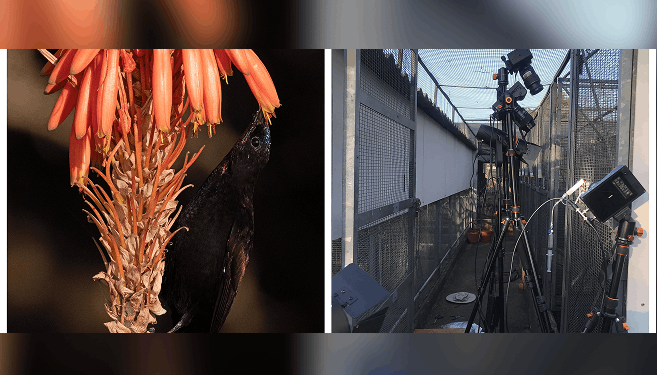
To uncover this hidden process, the research team filmed seven species of sunbirds feeding at up to 4 000 frames per second. Cuban designed and 3D-printed artificial flowers with transparent nectar chambers, helping researchers watch nectar moving through the birds’ partially transparent tongues in great detail.
South African sunbirds were captured in grassland and foothill habitats in KwaZulu-Natal’s uMgungundlovu District in 2022 and 2023. The feeding experiments were conducted in the outdoor Animal House aviaries on UKZN’s Pietermaritzburg campus. Artificial nectar, coloured with red food dye, enabled researchers to track its movement through the tongue using high-speed cameras. The team also examined tongue structure using microscopes and advanced 3D computed tomography scanning to better understand how the mechanism works.
“We’ve done lots of nectar work over the years, looking at birds’ guts and bills, but this work, looking at the physics of how they ingest nectar, is unique,” said Downs.
This discovery resolves a biological mystery and has important implications for understanding how nectar-feeding animals obtain the energy they need to survive. By understanding precisely how sunbirds feed, scientists can more accurately calculate their energy intake, improving models of their behaviour, ecology and interactions with flowering plants.
The findings also raise intriguing questions about whether other animals that feed on liquid foods may use similarly unexpected techniques, opening new avenues for research into the evolution of feeding mechanisms across the animal kingdom.
The research team acknowledged UKZN postdoctoral researcher Dr Jonah Gula, graduate Dr Lindokuhle Mhlongo, and Principal Technician Mr Ebrahim Ally for assisting with specimen collection. The study was funded by the Richard C. Snyder Award, the Margo & Tom Wyckoff Award, the Wilson Ornithological Society Research Grant, an American Ornithological Society Student Research Grant, and a Biodiversity: Discovery and Analysis grant from the United States of America’s National Science Foundation, as well as South Africa’s National Research Foundation through Downs’ South African Research Chair in Ecosystem Health and Biodiversity in KwaZulu-Natal and the Eastern Cape.
Words: Christine Cuénod
Photographs: Jonah Gula and David Cuban