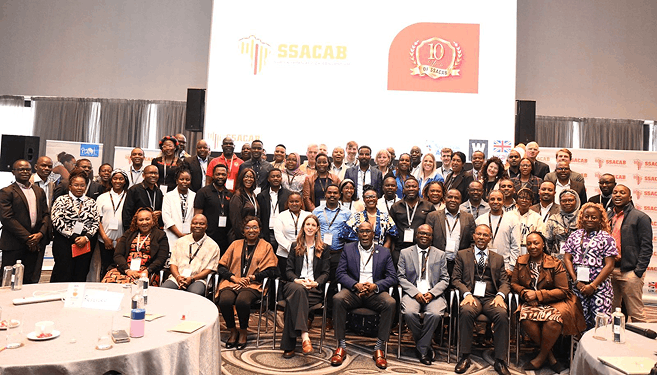
The University of KwaZulu-Natal (UKZN) was well represented at the 10th Annual General Meeting (AGM) of the Sub-Saharan Africa Consortium for Advanced Biostatistics (SSACAB), held in Nairobi, Kenya, where leading researchers and emerging scientists from across the continent gathered to celebrate a decade of advancing biostatistics and data science in Africa.
SSACAB is a pan-African, multi-institutional research and training consortium dedicated to developing cutting-edge statistical and data science methods, training the next generation of African biostatisticians, and strengthening evidence-based health policy across sub-Saharan Africa.
The consortium, which forms part of the Developing Excellence in Leadership, Training, and Science in Africa (DELTAS Africa) programme supported by the Science for Africa Foundation (SFA) with funding from the Wellcome Trust, brings together universities, research institutes and public health organisations to build sustainable biostatistical capacity across the continent. It is led by the University of the Witwatersrand (Wits) School of Public Health.
UKZN is one of the consortium’s partner institutions and leads research on developing advanced statistical methods for handling missing data in complex longitudinal health studies.
Through postgraduate training, collaborative research and methodological innovation, the consortium addresses major public health challenges including infectious diseases, non-communicable diseases, maternal and child health, climate-related health impacts and health systems research.
The Nairobi meeting marked a significant milestone as SSACAB celebrated its 10-year anniversary, recognising a decade of collaboration between researchers, universities and institutions committed to sustainably strengthening Africa’s capacity in biostatistics, statistical modelling and evidence-based research.
The anniversary celebrations were further enhanced by the launch of the book Statistical Modelling for Evidence-Based Public Health, published by Springer. The publication showcases modern statistical approaches to analysing complex public health data, including HIV/AIDS epidemiology and maternal and child health, while demonstrating how advanced biostatistical methods can support evidence-based decision-making across Africa.
Professor Henry Mwambi, from UKZN’s Discipline of Statistics in the School of Agriculture and Science, attended the AGM in his capacity as one of the consortium’s Co-Principal Investigators and was joined by a strong UKZN delegation comprising SSACAB alumni Dr Jesca Batidzirai, Dr Mohanad Mohammed and Dr Sarah Ogutu, current postdoctoral fellow Dr Anas Mohammed, and current PhD fellow Mr Abebe Zelelew.
The participation of both alumni and current fellows reflected UKZN’s ongoing contribution to developing highly skilled African biostatisticians through the consortium. Several UKZN postgraduate students have benefited from SSACAB fellowships, gaining opportunities to undertake advanced research while collaborating with leading experts from across Africa and internationally.
Mwambi noted that the consortium had become a model for collaborative capacity development in Africa: “Celebrating 10 years of SSACAB was a proud moment for everyone involved. Over the past decade, the consortium has demonstrated the power of collaboration in building African expertise in biostatistics and data science,” he said.
“UKZN has been privileged to play a leading role in this journey, and we are equally proud of the achievements of our students, alumni and researchers whose work is helping to strengthen evidence-based public health across the continent.”
Beyond celebrating past achievements, the AGM provided an important platform for consortium members to review progress, share research advances, discuss strategic priorities and strengthen collaborations for the next phase of the programme. Researchers showcased innovative statistical methodologies designed to improve the analysis of complex health data, supporting more informed policy development and public health interventions.
Since its establishment, SSACAB has created a sustainable pipeline for developing African expertise through master’s degree and doctoral training, postdoctoral fellowships, specialised short courses and collaborative research programmes. The consortium’s work continues to enhance the continent’s capacity to generate locally relevant evidence to address pressing health challenges while reducing reliance on external expertise.
“The continued involvement of UKZN academics and students in SSACAB reinforces the University’s reputation as a leading contributor to biostatistics, statistical modelling and data science research that addresses Africa’s health priorities and supports evidence-based decision-making for improved public health outcomes,” said Mwambi.
Words: Sally Frost
Photograph: Supplied