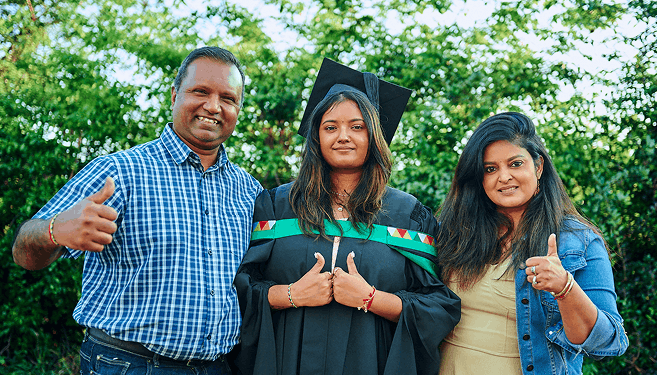
Exploring how bioacoustics technology and artificial intelligence (AI) could contribute to the monitoring and management of invasive bird species was the focus of research by Ms Jezelle Madhan, who graduated with a Master of Science in Biological Sciences from the University of KwaZulu-Natal (UKZN).
Madhan’s dissertation: ‘Advancing Bioacoustics Technology for Contingency Plans in Invasive Bird Species Management – A Bioacoustic Pipeline using Acridotheres tristis as a Model’, was supervised by Dr Anna Che Bastian.
Said Madhan: “Essentially, I was trying to understand what these birds were ‘saying’ and whether we can use their sounds to monitor them.”
Having completed both her undergraduate and honours degrees at UKZN, Madhan chose to pursue her MSc at the University as she was already familiar with its research environment. “I also wanted to build on my previous experience in animal behaviour and develop my skills in research, particularly in bioacoustics and the use of technology to study animals,” she said.
Her research focused on the calls of the Common Myna, an invasive bird species found throughout South Africa. She studied the different types of calls they produced and used sound-recording technology and AI to determine whether these calls could be reliably detected and classified.
“The long-term idea is that bioacoustic technology can help researchers and conservationists detect, track and monitor invasive species more efficiently without always needing to observe them physically.”
Madhan’s interest in this research stemmed from her passion for animals, wildlife and nature as well as her desire to contribute to biodiversity conservation. She found bioacoustics particularly exciting because it combined her interest in animal behaviour with technology.
“Animals constantly produce sounds, which can provide valuable information about their behaviour and communication,” she explained. Manually analysing large amounts of recordings can be extremely time-consuming, however, prompting her interest in automated sound recognition and artificial intelligence.
The Common Myna was particularly interesting to her because it is an invasive species, giving the research a clear conservation application.
“Improving the ability to detect and monitor its calls can contribute to better understanding and management of the species and to the development of more efficient ways to monitor it,” she said. “Traditional monitoring can require researchers to spend many hours in the field visually locating and identifying animals, while bioacoustics provides another approach in which sound recordings can potentially be collected continuously and analysed automatically.”
Madhan hopes her research will demonstrate how technology can be combined with animal behaviour and conservation to answer ecological questions that might otherwise be difficult to study.
She plans to continue working in animal behaviour and conservation, particularly in research combining technology with ecological questions. She is particularly interested in bioacoustics, conservation, automated acoustic monitoring and animal behaviour analysis.
“Ultimately, I would love to work in a research or conservation environment, potentially in a game reserve or other natural environment, where I can study animal behaviour while contributing to conservation,” she said.
Madhan credited God, her parents and her best friend, Ms Shareefah Ismail, for supporting her journey. She also thanked her supervisor for helping develop her confidence and independence as a researcher as well as university students and colleagues who shared their knowledge and supported her.
Outside academia, Madhan enjoys gaming, reading novels, drawing, painting, crocheting, listening to music, spending time outdoors, hiking, go-karting and exploring new places!
She shared the mindset she tries to live by: “Everything happens for a reason. This approach helps keep my heart and mind open, helps me work harder and focus on what I can do rather than dwelling on what I cannot change.
“Life is beautiful, and I think we have the power to make our own story a beautiful one,” she said.
Words: Sally Frost
Photograph: Sethu Dlamini