Mr Keshav Bechoo, who graduated with a master’s degree, has always been fascinated by the universe and how it works.
This curiosity ultimately led him to pursue his MSc research with the HIRAX project under the supervision of Professor Kavilan Moodley. “I really admired my supervisor for his approach to research and mentorship, making UKZN the ideal place for me to pursue my postgraduate studies,” said Bechoo.
This decision was driven by a unique opportunity for Bechoo to be part of the groundbreaking HIRAX (Hydrogen Intensity and Real-time Analysis eXperiment) project. The project, currently being built in the Northern Cape in the Karoo desert, is a radio telescope array which will eventually consist of 1 024 dishes aimed later this year. Drawn to both the complexity of the project and South Africa’s pioneering role in radio astronomy, Bechoo found the environment at UKZN to be the perfect fit. His academic journey, shaped by curiosity, technical skill and strong mentorship, reflects both a passion for understanding the universe and a commitment to advancing scientific research. His research focuses on the study of radio signals emitted from the universe.
Bechoo worked on improving how scientists collect and interpret these signals to understand the structure and evolution of the universe better, titling his thesis: ‘On-Sky Characterisation and Analysis of HIRAX Prototype and Dish Verification Array’. His focus was on data calibration and reducing interference (radio frequency interference – RFI) caused by man-made radio signals, as such interference can significantly disrupt astronomical observations.
The significance of his research lies in its contribution to improving the accuracy and reliability of data collected by radio telescopes. “Even minor errors or interference can impact scientific conclusions,” said Bechoo.
Describing his passion for astronomy, he said: “I have always been fascinated by the universe and the fundamentals of how it works. During my studies, I became interested in the challenge of extracting information from the universe. This naturally led me to radio astronomy, where physics and engineering come together.” Looking ahead, Bechoo plans to continue his academic journey by pursuing a PhD at UKZN.
He aims to explore cosmology, radio telescopes and engineering further, building on his current expertise while continuing to contribute meaningfully to scientific discovery.
Throughout his journey, Bechoo has been supported by a strong network of people. His family has been a constant source of encouragement and motivation, while his supervisor provided invaluable academic guidance and mentorship. Being part of the HIRAX team also offered him a collaborative and enriching experience, helping him shape his growth as a researcher.
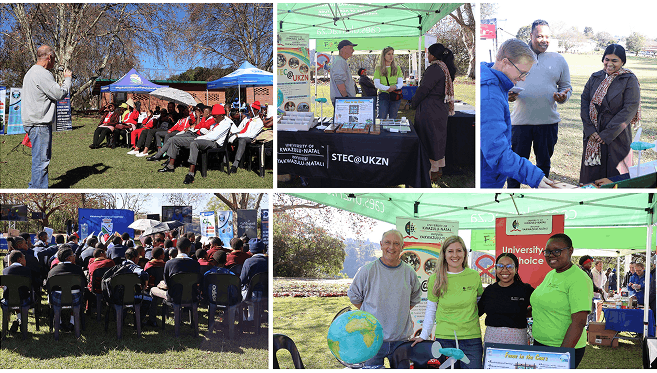
Bechoo makes significant contributions to the HIRAX outreach programme where he encourages and enlightens learners and the general public about the advancements of radio astronomy in South Africa.
Outside of his academic pursuits, Bechoo maintains a well-rounded lifestyle. He enjoys spending time with his family, playing the guitar and exploring creative outlets through art and music activities that help him maintain a healthy balance between work and personal life. Reflecting on his journey, he said he was thankful for the opportunities he has received. His advice to aspiring students is: “Always pursue your curiosity, stay dedicated and embrace the challenges that come with tackling complex problems.”
Words: Prashina Ramcharan
Photograph: Sethu Dlamini