The Discipline of Mathematics in the School of Agriculture and Science hosted a week-long Workshop and Conference on Computational Mathematics and Modelling (WOCCCOM) on the University of KwaZulu-Natal’s (UKZN) Pietermaritzburg campus.
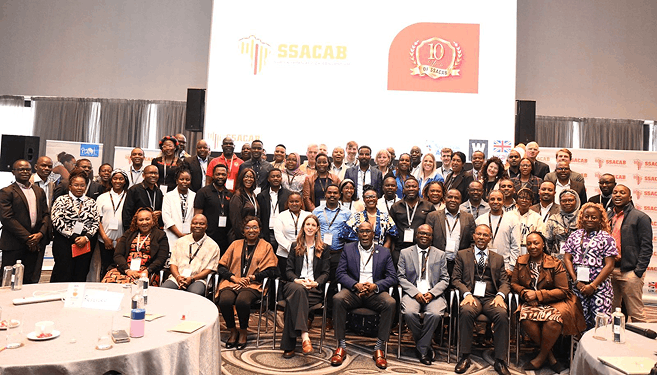
The 18th edition of the annual event drew a record 100 delegates from various Southern African institutions.
“This year marks another milestone for our community,” said Professor Precious Sibanda. “What began in 2008 as a focused initiative to foster growth in computational mathematics among mostly postgraduate students has matured over nearly two decades into a premier annual gathering.”
He highlighted that the high number of registrations, up from 60 to 80 participants in most preceding years, reflected the vibrant and sustained relevance of the series.
Delegates came from UKZN, the University of the Witwatersrand (Wits), the Universities of Eswatini, Johannesburg, Limpopo, and Venda, Cape Peninsula University of Technology, Rhodes University, Unisa, Nelson Mandela University, North-West University (NWU), Sefako Makgatho Health Sciences University, the South African Weather Services (SAWS) as well as Manica University in Zambia. Delegates from North-Eastern Hill University in Shillong, India, joined online.
Sibanda explained that the event incubated the next generation of mathematical talent, with its mission being to teach and equip through an intensive three-day workshop component that introduced innovative numerical methods and computational ideas, and to connect and collaborate through a programme designed to facilitate networking and enable formal and informal research collaborations. The workshop focused on generative artificial intelligence for the scientific code generation, climate modelling and the hybrid block method for solving differential equations.
The local organising committee comprised UKZN staff members, including Sibanda, Honorary Associate Professor Sandile Motsa, Professor Sicelo Goqo, and Dr Hloniphile Sithole-Mthethwa.
Dr Olumuyiwa Otegbeye, Dr Thama Duba, Dr Yusuf Olatunji Tijani and Dr Titilayo Agbaje attended from Wits University, Dr Shina Daniel Oloniiju from Rhodes University, and Dr Vusi Magagula from the University of Eswatini.
The organising committee acknowledges generous sponsorship from the Department of Science, Technology and Innovation – the National Research Foundation Centre of Excellence in Mathematical and Statistical Sciences (CoE-MaSS), and UKZN. They also received support from the Hanno Rund fund through Professor Gareth Amery, and temporary Matlab licenses access from Opti-Num Solutions.
The two-day conference component featured 28 postgraduate student presentations in parallel sessions, with themes including climate models, block hybrid methods for boundary value problems, and the effective use of Large Language Models (LLMs) in numerical approximations.
Sibanda thanked Motsa, Oloniiju, Mr Mpho Nefale of Wits, and Mr Siyabonga Nozwane and Dr Nosipho Zwane of SAWS for facilitating the workshop, and Professor Thando Ndarana of the University of Pretoria and Professor Montaz Ali from Wits for their plenary presentations on the dynamics of extratropical weather systems affecting Southern Africa and a linear predictor of a non-linear dynamical system with applications, respectively.
UKZN’s Ms Amna Ibrahim received the award for the best PhD presentation for her talk titled: ‘Stability Analysis and Optimal Control of a Hepatitis C Virus (HCV) Model with Immune Response’, while Mr David Moseki of NWU received the award for the best master’s presentation speaking on: ‘Sensitivity Analysis for Nanofluid Flow Driven by Thermal and Mass Diffusion through a Rotating Convergent/Divergent Channel’.
Closing the conference, Duba thanked students for their presentations and emphasised that the evaluations were intended to help them improve. She also thanked universities for their growing participation in WOCCCOM.
Words and photograph: Christine Cuénod