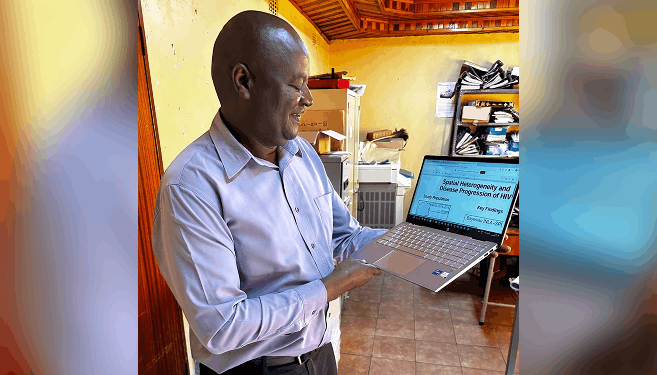
Dr Exaverio Chireshe graduated with a PhD in Statistics from the University of KwaZulu-Natal (UKZN), following his research that applied advanced statistical approaches to understanding the complex patterns of HIV in KwaZulu-Natal.
His thesis, titled: ‘Modelling HIV Syndemics Using Bayesian Spatial and Latent Variable Approaches: A Case Study from KwaZulu-Natal, South Africa’, was supervised by Professor Retius Chifurira, Professor Knowledge Chinhamu and Dr Jesca Batidzirai.
Chireshe said UKZN’s strong reputation in statistics, public health research and interdisciplinary research motivated him to pursue his doctoral studies at the University.
His research focused on understanding how HIV prevalence varies across different communities in KZN and how different factors may interact to influence HIV-related outcomes.
“I used advanced statistical methods to study not only how many people are affected by HIV, but also where higher levels of HIV occur, how neighbouring communities may be related, and how demographic, behavioural and clinical factors interact,” explained Chireshe.
A key aspect of the research was recognising that HIV does not occur randomly across a landscape with some areas having substantially higher levels of HIV than others. Chireshe developed and applied statistical models that could identify these spatial patterns while accounting for uncertainty in the data, with the ultimate aim of providing a more detailed understanding of HIV patterns to support better targeted public health planning and interventions.
Said Chifurira: “Advanced Bayesian statistical methodology is fundamental to analysing complex epidemiological data characterised by spatial dependence, temporal variation, nonlinear relationships, and multiple correlated health outcomes.
“Dr Chireshe’s thesis addressed these challenges through the development of complementary Bayesian geospatial, hierarchical, latent variable, and machine learning modelling frameworks. His study makes a significant contribution to applied statistics and epidemiology, with research contributions featured in five publications in high-ranked international journals.”
Chireshe’s interest in the field developed from his statistics background and his desire to use the discipline to address real-world problems.
“HIV remains an important public health challenge in South Africa, particularly in KwaZulu-Natal,” he said. “I became interested in how statistical modelling could go beyond reporting overall HIV prevalence and instead help us understand the geographical and underlying patterns of the epidemic.”
Chireshe believes the significance of his research is both methodological and practical. From a statistical perspective, it brings together advanced approaches that are often considered separately, demonstrating how spatial statistics, Bayesian modelling, latent-variable methods, geostatistical approaches and machine learning can complement one another when analysing complex health data.
From a public health perspective, the research provides a more detailed picture of HIV patterns in KZN. The models help identify areas with elevated levels of HIV and quantify the uncertainty associated with those estimates – information that is important when health resources are limited and geographically-targeted interventions and planning are required.
Although the research focused on HIV, Chireshe said the statistical approaches developed and applied in the study could also be useful for other public health and environmental problems where data have geographical, temporal and multivariate structures.
Looking ahead, his goal is to grow further as an academic and statistician through a career combining teaching, research and community impact.
“I would like to publish more of my research in high-quality, peer-reviewed journals and continue developing my expertise in statistical modelling, Bayesian statistics, spatial statistics and data science,” he said.
He also hopes to contribute to teaching, research and academic mentorship at a university, supervising and mentoring undergraduate and postgraduate students and helping to develop the next generation of statisticians.
He thanked his supervisors as well as Professor Ayesha Kharsany of the Centre for the AIDS Programme of Research in South Africa (CAPRISA) and also acknowledged CAPRISA for providing access to the dataset that made the research possible.
His wife and children, brothers Professor Regis Chireshe and Dr Amato Chireshe, friends Dr Kufakunesu Zano and Mr Peter Chatiza, and his wider family, friends and colleagues were also thanked for their support throughout his doctoral journey.
Chireshe enjoys spending spare time with family and friends, reading, learning about developments in statistics and data science, and pursuing ideas for his professional development.
“Completing a PhD has been a challenging but very rewarding journey,” he said. “It has taught me that research is not only about finding answers, but also about asking better questions, being persistent when things do not work as expected, and remaining open to learning.”
Words: Sally Frost
Photograph: Supplied