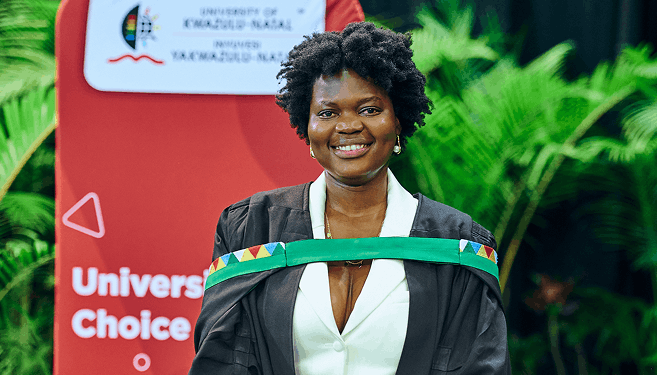
Dr Sbongiseni Xolo’s PhD graduation is a celebration of perseverance and passion for the husband, father, and student leader whose research on alien and invasive invertebrates provides practical tools to improve biosecurity planning, policy development and early detection of high-risk species.
In his thesis: ‘Species Distribution Modelling of Alien and Invasive Invertebrate Species in South Africa’, Xolo investigated alien and invasive terrestrial invertebrates, documenting 718 species and their pathways of entry, prioritising species for management, and modelling how climate change could shape future invasion hotspots.
Invasive species threaten biodiversity, agriculture, and food security, and can serve as vectors of plant, animal and human diseases. Xolo was surprised to discover more than 700 alien terrestrial invertebrate species in South Africa, revealing the scale of biological invasions.
His research highlighted the need for stronger border biosecurity and produced a practical framework to prioritise high-risk invasive species. His modelling also found that rainfall variability may be a stronger predictor than temperature of future invasion hotspots under climate change.
Xolo, who completed his undergraduate, honours and master’s degrees at the University of KwaZulu-Natal (UKZN), chose the Institution for its academic quality and research environment. He benefited from mentorship, research opportunities and a supportive learning community.
“I was fascinated by the diversity of insects and their enormous influence on ecosystems, agriculture, and human society. What keeps me passionate about the field is its relevance to biodiversity conservation, food security, and environmental management,” said Xolo.
He plans to pursue a postdoctoral fellowship at UKZN focusing on biosecurity, climate change impacts, species distribution modelling and invasive species management, with long-term goals of working in academia and research to advance teaching and environmental conservation.
Coming from a small rural community in Port Shepstone, Xolo admitted he did not enjoy school and was often forced to attend by his grandparents, who themselves had not received formal schooling. He credits their determination for sparking his development.
Graduation marked the culmination of a journey that included COVID-19 disruptions, delayed studies, unreliable internet access and the demands of supporting his wife and four sons. He considered giving up, but credited his wife, mentors and supervisors with helping him complete his PhD.
Student leadership was another important chapter. Former Residence Life Coordinator Mr Thabani Chagi’s confidence in him led to Xolo helping manage more than 1 000 postgraduate students in Denison Residence, sharpening his leadership and communication skills. Teaching opportunities at UKZN and the Durban University of Technology further developed his teaching philosophy.
Xolo thanked his family, friends, librarians, classmates, colleagues, mentors and supervisors, particularly his late grandparents, Mrs Maphehlukwayo and Mr Ntuli, as well as his funders, the Foundational Biodiversity Information Programme under the National Research Foundation.
“From a young boy who disliked school and had to be forced into the classroom, to becoming Dr Sbongiseni Xolo, my story is proof that perseverance, faith, support, and education can change a life,” said Xolo.
Words: Christine Cuénod
Photograph: Sethu Dlamini