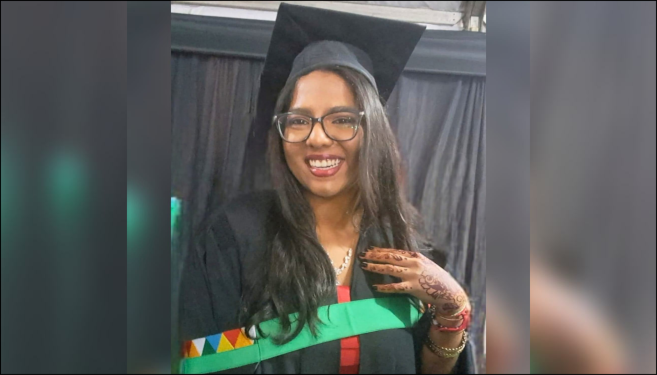
For MSc cum laude graduate Ms Saarisha Govender, a fascination with quantum computing that began during her Honours studies has developed into a research journey that is taking her towards a PhD in Physics.
Govender chose to remain at the University of KwaZulu-Natal (UKZN) for her Master’s degree because of the Discipline of Physics’ active contribution to quantum physics and quantum computing research. The opening of the Centre for Quantum Computing and Technology (CQCTec) and the opportunity to work with researchers in the field, including her supervisor, Professor Ilya Sinayskiy, further strengthened her decision.
“UKZN became the most natural choice for me to pursue my Master’s degree,” she said.
Her MSc research, titled: “The Cross-Kernel Margin: A Robustness Measure for Quantum Kernel Methods”, was both computational and analytically focused. It examined the effects of noise on a quantum machine learning model called the quantum kernel-assisted support vector machine.
“Current quantum computers are affected by noise, which can introduce errors when performing computations and consequently produce unreliable results,” explained Govender.
Her research introduced a new way of determining how much the model changes when it is subject to disturbances such as noise and used mathematical techniques to derive bounds on the extent of this change.
The research has already made its way beyond the dissertation. The manuscript, also titled: “The Cross-Kernel Margin: A Robustness Measure for Quantum Kernel Methods”, recently completed the peer-review process and has been published in Advanced Quantum Technologies. A design that she created to visually represent the research in the manuscript has also been accepted by Advanced Quantum Technologies as cover artwork.
Govender said the practical challenge of noise in present-day quantum computing was one of the factors that attracted her to the research area, while the combination of computational and analytical work further fuelled her interest.
“My research introduces a new measure for quantifying how robust this quantum machine learning model is to perturbations such as noise,” she said. “This is particularly relevant in the present moment due to the unavoidable and detrimental effects of noise on quantum computation.”
While pursuing her research, Govender also discovered a renewed appreciation for teaching. During the later stages of her MSc, while awaiting her examination results and preparing her manuscript for publication, she worked as a first-year Mathematics lecturer for students in the School of Computer Science and in the Faculty of Commerce at Emeris (formerly Varsity College) in Durban North.
She credits her students with helping her through a particularly challenging period.
“The enthusiasm, curiosity and endless questions of my students made me look forward to every single day in those classrooms,” she said. “Before becoming a lecturer, I don’t think I ever realised just how much space a group of students could occupy in your heart.”
The experience reinforced her desire to combine teaching with research and to engage with young people through scientific outreach.
Govender’s commitment to representation in science was also reflected in her recent participation in a National Institute forTheoretical and Computational Sciences (NITheCS) Mini-school inspired by Women’s Month, where she presented a talk on Ada Lovelace, widely considered the first computer programmer. The mini-school, “Celebrating Underrepresented Women in Theoretical and Computational Sciences”, explored remarkable women whose contributions to science have historically been overlooked.
Looking ahead, Govender is pursuing her PhD in Physics and hopes to contribute positively to quantum computing research while continuing to teach and participate in scientific engagement and outreach.
“I believe that representation in science is extremely important and that young people should be able to look at scientists today and see themselves in those roles tomorrow,” she said.
She attributes her journey to the unwavering support of her family and friends, her students and colleagues, and particularly Professor Sinayskiy, whose mentorship has been a constant throughout her university education.
“Thanks to his mentorship, I am currently living the wildest, most out-of-reach academic dream that the thirteen-year-old version of me, who first dreamed of earning her PhD, could ever have imagined,” said Govender.
Outside academia, she prioritises her physical and mental wellbeing through strength training, cardio, Pilates, meditation and breathwork. She also enjoys cooking, reading novels and taking long evening walks. As she continues her academic journey, Govender hopes to contribute not only to the advancement of quantum computing but also to creating a future in which more young people can see themselves as scientists.
Words: Sally Frost
Pic: Supplied.