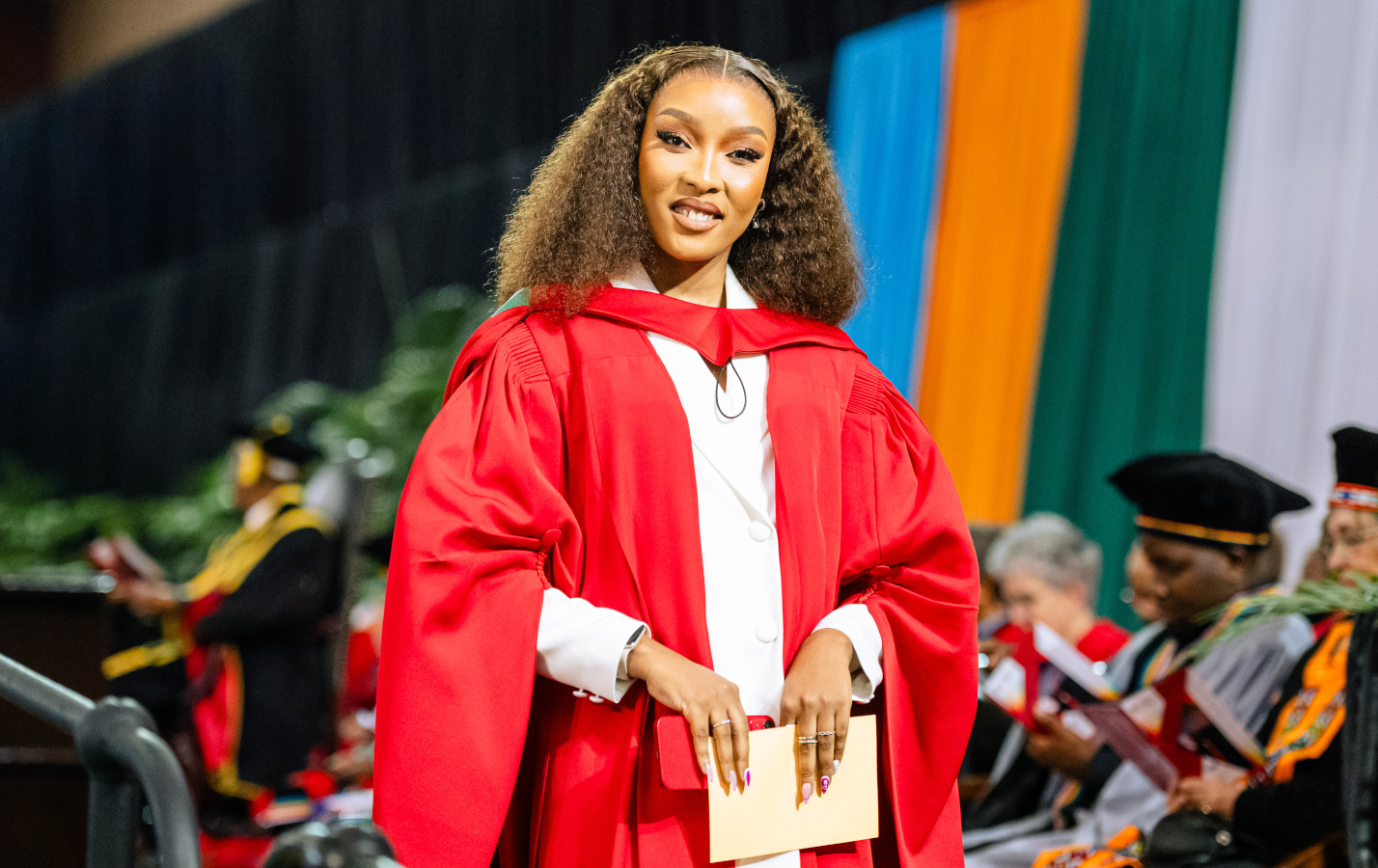
Dr Nokwanda Hendricks began her schooling at Dibase Primary School and and later attended Asiphikelele High School in the Nkolokotho area of Mtubatuba, where her passion for Chemistry first took root. Her grit and striving for academic excellence led her to the University of KwaZulu-Natal (UKZN), where she embarked on what she describes as a long, “intellectually stimulating and personally transformative” path towards becoming Dr Nokwanda Hendricks.
Although she insists she was just an “above average learner”, her academic achievements tell a different story. At UKZN, Hendricks received bursaries and research grants from prestigious organisations, including the National Skills Fund, the National Research Foundation of South Africa, the Water Research Commission in partnership with the uMngeni Water Chair, and the Western Indian Ocean Marine Science Association–Marine Research Grant I (WIOMSA-MARG I). These awards reflect not only her academic calibre but also her determination to strive for excellence..
After completing her Bachelor of Science degree in Chemistry and Chemical Technology, Hendricks pursued her Honours in Chemistry and later Master of Science in Chemistry (Cum Laude). Fueled by her passion for research and her desire to advance knowledge in the field of environmental chemistry, she registered for her Doctor of Philosophy degree.
Hendricks’ PhD research, titled Ecological Risks Assessment of Emerging Organic Particle Contaminants in Wastewater and Aquatic Environments: Nano Fullerenes and Microplastics, focused on standardising analytical methods to detect and quantify microplastics and fullerenes in aquatic environments. “Microplastics and nanomaterials (nano fullerenes) are prominent pollutants in wastewater, marine and freshwater systems, posing significant ecological and health risks. Studying their presence and behaviour in different water bodies is critical for understanding and mitigating these impacts, “ Hendricks explained.
“Dr Hendricks spent several days at sea, sampling in Algoa Bay and St Francis Bay in the Eastern Cape. Her determination to address environmental challenges is indisputable,” said Dr Bhekumuzi Gumbi, Hendricks’ supervisor.
The inspiration behind Hendricks’ PhD research stems from her passion for chemistry and desire to address critical challenges in water quality and sustainability, a commitment shaped by her experience relying on the uMfolozi River growing up, which was contaminated by a nearby game reserve and a coal mine. “This motivated me to undertake a study to improve water quality and make the community aware of such issues,” she said.
Explaining the societal impact of her research, Hendricks said: “This research aimed to bridge the gap between scientific knowledge and community understanding, empowering citizens to monitor water quality and identify pollution sources, safeguarding freshwater and marine ecosystems as well as human health and well-being”.
Hendricks described her journey as one that “represents years of perseverance, overcoming challenges and the fulfilment of a long-held ambition”.
Her supervisor, Dr Bhekumuzi Gumbi, described Hendricks as a dedicated student who paid close attention to detail. “Supervising her was not difficult, as she had a genuine passion for research and came to the lab almost every day,” he said.
Hendricks is currently a Postdoctoral Research Fellow, preparing for a career in research and academia while also assisting the College’s PR team with outreach initiatives. In her free time, she tutors science subjects to high school learners in the Nkolokotho area, giving back to her community.
Hendricks acknowledged the unwavering support of her family throughout her academic journey. “I would like to thank my mother, Ms Ntombiyenhlanhla Eveness Mkhwanazi, and my siblings for being with me throughout the journey. They have been patient and supportive from my undergraduate years onwards,” she said.
Words: Nqobile Mthuli
Pictures: supplied