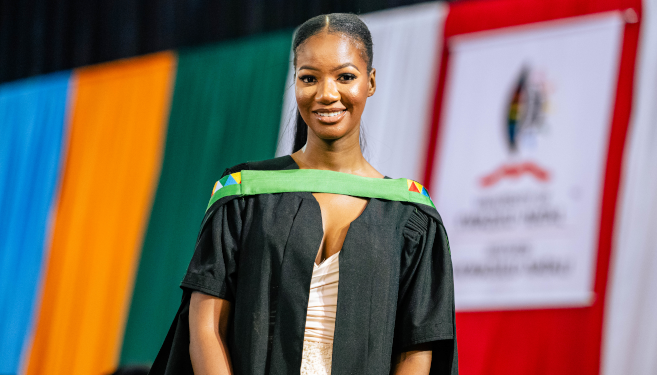
Ms Reabetswe Moipolai’s graduation with a Master’s in Agricultural Economics brings full circle her journey from the small village of Kaalpan in the North West Province to where she is now – an accomplished graduate whose research explored the impact of the Presidential Employment Stimulus Initiative (PESI) in the district where she grew up.
Coming from a place where many people practised smallholder farming, Moipolai knew she wanted a career in agriculture and a high school teacher, ‘Mr Mabala’, encouraged her to concentrate on agricultural economics, a subject she had never heard of. Enrolling at the North-West University’s Mafikeng campus, Moipolai discovered that the subject enabled her to explore economic solutions to a wide range of problems, from political to social.
The first in her immediate family to achieve a university degree, Moipolai was inspired to succeed by her mother, who runs a small business selling fresh meat in several villages.
This sparked her interest in specialising as an economist in academia or in the banking profession, and the advertisement for an opportunity in a Water Research Commission (WRC) study headed by Professor Edilegnaw Wale Zegeye at UKZN, led her to the Institution where she was able to shape the topic according to her experience.
Moving to a new city was not without its challenges; Moipolai had previously been able to live at home while working for the provincial Department of Agriculture after her undergraduate studies.
In Pietermaritzburg she joined the campus volleyball club which helped her find belonging and balance the demands of her studies, while fellow students in agricultural studies were helpful and open. A delay in payments in 2024 meant she spent more than four months at home, relying on the support of her grandmother and family and trying to complete her research despite poor network coverage.
Her master’s research involved evaluating the impact of the PESI programme on the livelihoods of smallholder farms in the Ngaka Modiri Molema District Municipality, where she is from, particularly in terms of household food security status and the perceptions of farmers towards the programme.
The programme was implemented online during the COVID-19 pandemic, a unique new idea for a predominantly older target group in remote areas, with varying levels of education.
Consistent with findings in other countries with similar programmes, Moipolai found it did have an impact on household food security status, and their perceptions were mainly influenced by factors such as age, education level, income, communication channels, and information and communication technology usage. She found it interesting that the involvement of extension officers, access to social media, and participation in farmer groups did not influence the farmers’ perceptions, which was the case in other places implementing voucher-based input support programmes.
Supervised by Ms Raesetse Baloyi, Moipolai presented her research at the South African Society for Agricultural Extension Conference, where she was nominated as one of the Top 10 Best Papers submitted and placed second in the Best Oral Presentation category.
Moipolai has joined a Nedbank internship programme and plans to pursue her PhD at UKZN next year.
She thanked her family, friends, campus office mates, the volleyball club, the National Research Foundation, WRC, Baloyi, and colleagues at Nedbank who provided support and encouragement through her master’s studies. She also acknowledged the Department of Agriculture and the Ngaka Modiri Molema District Department of Agriculture, especially in Ditsobotla, for facilitating her study.
Words: Christine Cuénod
Photograph: Sethu Dlamini