

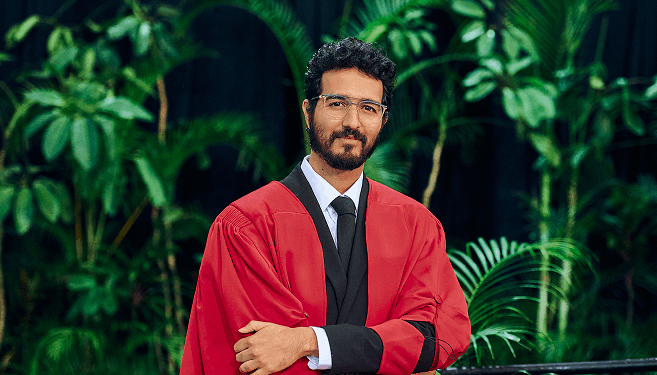
Curious about the foundations of the universe, Dr Shamik Maharaj’s decision to pursue a PhD in Physics at the University of KwaZulu-Natal (UKZN) was motivated by his interest in expanding the research he did for his master’s degree.
Maharaj also wanted to continue working with his supervisor, Professor Thomas Konrad, whom he regards as an “incredibly supportive” mentor.
Together, they developed an optimistic idea to indirectly tackle the problem of quantum gravity – a concept he acknowledges is both exciting and extremely challenging.
“Where many people would say the idea is too unrealistic for a PhD student, Prof Konrad was nothing but supportive,” he said.
Maharaj’s research focused on the relationship between quantum measurement, particle dynamics and gravity.
“In the quantum world, monitoring the position of a particle is essential if we want to use the particle for quantum technology, such as quantum computing,” explained Maharaj. “Measuring the initial position of a particle is not straightforward, however, as every measurement ‘pushes’ the incredibly small particle away from its original position.”
Applying many continuous measurements with finely tuned measurement strength allows predictable dynamics to be engineered – exploring the potential forms of these dynamics is essentially what Maharaj’s research investigates.
One of his most fascinating findings was that the measurement force can be tuned to make a particle ‘feel’ the same gravitational attraction predicted by Sir Isaac Newton’s Law of Universal Gravitation.
“The implication is that a mechanism of continuous measurement may be at play in the background of the universe, synthesising the force of gravity and allowing our classical world to emerge from quantum waves,” he said.
Maharaj’s fascination with this field stems from a longstanding interest in the foundations of the universe. Rather than focusing primarily on the latest technological developments, he preferred to return to foundational principles, examine their implications and explore aspects that remain poorly understood, such as the measurement problem.
“The answer to questions such as ‘where did we come from and where are we going?’ will always draw me back to foundational physics,” he said.
His research is significant because it “pushes forward” the mathematical framework of state preparation schemes, which is useful for the creation of effective quantum technology. It also opens the doorway to simple models of semi-classical quantum gravity that could be used to design experiments to probe the nature of gravity at the smallest scales of the universe.
On his future, Maharaj said: “I plan to continue with my research as well as lecturing eager young minds to ignite the spark of curiosity within them.”
He credits several people for helping him reach the PhD milestone, including his supervisor; his parents and grandparents who created a loving environment that enabled him to focus on his research; and his girlfriend, Ms Kelisha Pandaram, for consistently encouraging and celebrating his achievements.
Away from physics, Maharaj enjoys painting landscapes, particularly mountains.
“There is something about the majesty of mountains that makes everything else feel small and insignificant,” he said. “It is a similar feeling to what I’ve experienced when studying the universe through my research.”
Words: Sally Frost
Photograph: Sethu Dlamini


