

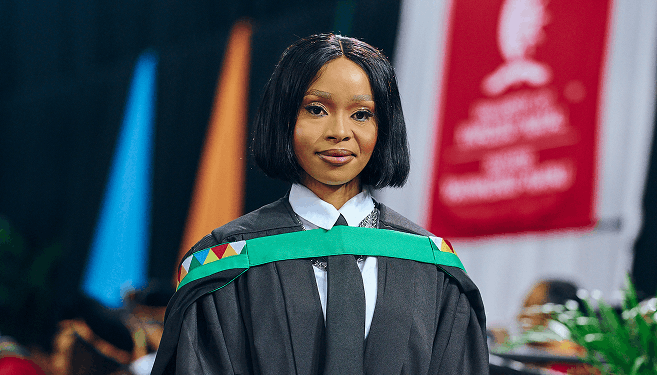
Research into the relationship between land-use, land-cover change and human-wildlife conflict around the Hluhluwe-iMfolozi Park secured Ms Ongeziwe Njomi a Master of Science in Environmental Science degree from the University of KwaZulu-Natal (UKZN).
Supervised by Professor Michael Gebreslasie, Njomi’s dissertation was titled: ‘Remote Sensing of Land-Use and Land-Cover Change and its Impact on Human-Wildlife Conflict around Hluhluwe-iMfolozi Park, KwaZulu-Natal, South Africa’.
“I chose to do my MSc at UKZN because I had already developed a strong interest in Environmental Science during my undergraduate studies there,” said Njomi. “UKZN provided a good academic environment for me to further develop my research skills, particularly in Geographic Information Systems (GIS) and remote sensing.”
She also valued the opportunity to conduct research relevant to KwaZulu-Natal while working with supervisors who could guide and support her development as a researcher.
Njomi’s research investigated how changes in land use and land cover around Hluhluwe-iMfolozi Park could influence human-wildlife conflict and also how the landscape had changed over time, including changes in vegetation, cultivated areas and built-up areas as well as how these changes related to where conflicts between people and wildlife occurred.
The research addresses an important environmental and conservation challenge, as human-wildlife conflict can have serious consequences for both surrounding communities and wildlife.
“By understanding how changes in the landscape are linked to these conflicts, we can identify areas that may be more vulnerable and provide information that can support better land-use planning, conservation and conflict management,” she said.
Her interest in the field grew from her background in Environmental Science and an increasing fascination with using GIS and remote sensing to understand environmental change.
Njomi became particularly interested in the relationship between changing landscapes and human-wildlife interactions because of the complex ways in which these environmental challenges affect both conservation efforts and surrounding communities.
“I wanted to use geospatial technology to gain a better understanding of these patterns and hopefully contribute to practical solutions,” she said.
Njomi believes the significance of her research lies in demonstrating how changes in the landscape can be used to understand patterns of human-wildlife conflict better. She says the findings could potentially assist conservation managers, planners and surrounding communities in identifying areas requiring greater attention and intervention.
More broadly, she hopes her research demonstrates how remote sensing and GIS can serve as practical tools for understanding environmental change and supporting environmental management and conservation.
Njomi plans to do a PhD and continue developing as a researcher, with a particular focus on remote sensing, GIS and environmental monitoring. “I hope to build a career in which my research can help address real-world environmental challenges in South Africa and beyond,” she said.
She is also interested in academia and hopes to combine research with teaching. Having had opportunities to teach and assist students during her academic journey, she developed an interest in helping students understand and apply environmental and geospatial concepts.
“I would like to contribute to both research and education, helping develop the next generation of environmental scientists,” she said.
Njomi paid tribute to her supervisor, whom she said had challenged her academically, guided her research and encouraged her to think more critically about her work. She also acknowledged her mother, lecturers, colleagues and friends.
“Reaching this stage has not been an individual journey but one supported by many people along the way,” she said.
Away from her academic work, Njomi enjoys spending time with family and friends, listening to music, watching football, reading fiction and being outdoors.
Grateful for the opportunity to complete her MSc at UKZN, she said the journey had challenged her academically and personally while allowing her to grow in confidence and develop as a researcher.
“My MSc has strengthened my passion for Environmental Science and has motivated me to continue learning and growing in this field,” she said. “I hope to build on what I have learned and use my knowledge and skills to contribute meaningfully to environmental research and conservation in South Africa.”
Words: Sally Frost
Photograph: Sethu Dlamini


